

Killing time
vs. Catching up
I have accumulated an embarrassingly large stack of books in the past year. I like a big TBR pile because I like to have choices. But this is getting out of hand. I don’t know.
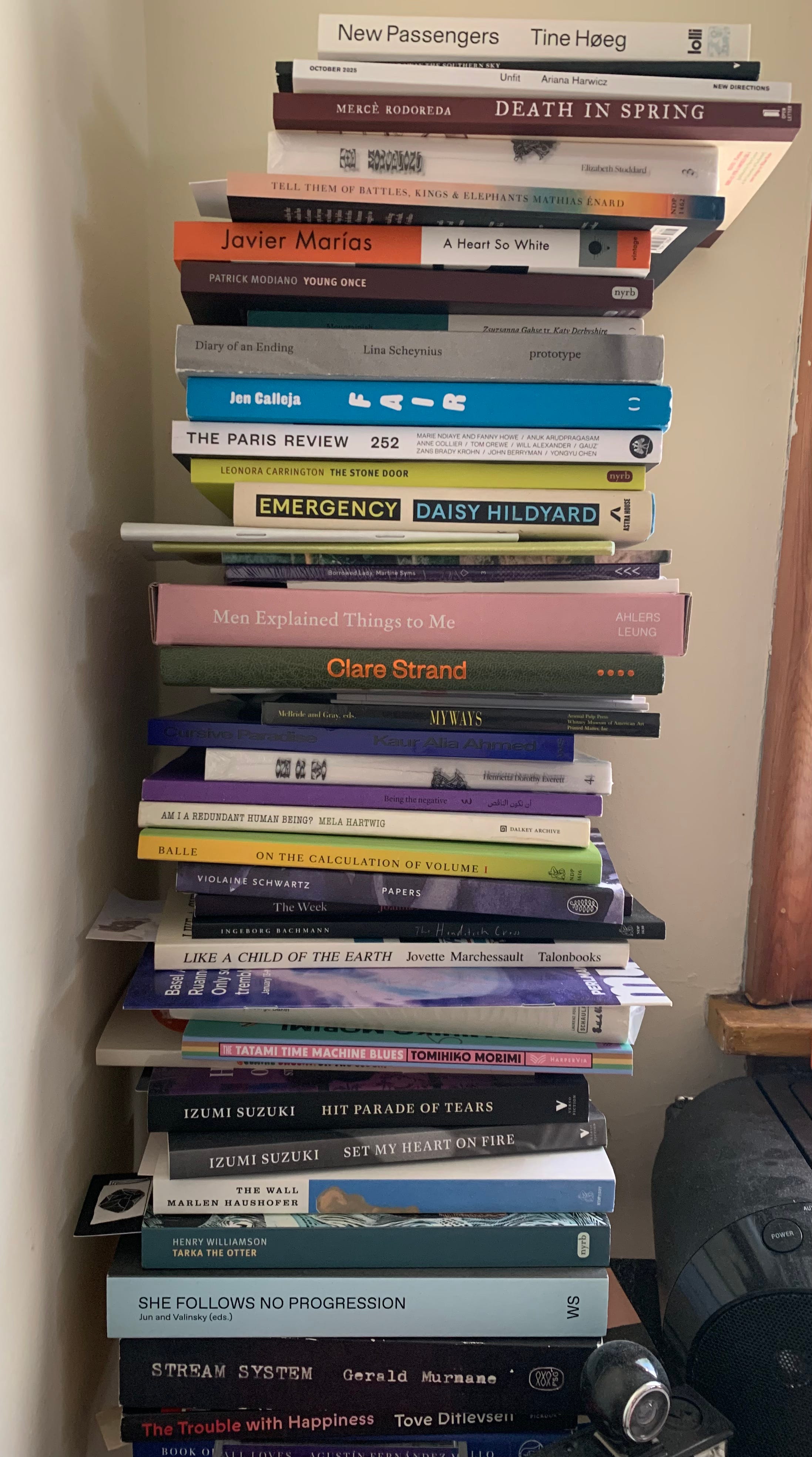
This isn’t even counting everything I’ve requested from the library over the past several weeks. I just acknowledge that there are books here that I will get to when I get to them, and it may be a while. Between teaching, book stuff, and book club, life, what I’m reading feels all over the place. This weekend, I opted to read The Man of Feeling by Javier Marías, translated from Spanish by Margaret Jull Costa. It’s the longest novel I’ve read in a while, but it’s less than 200 pages, and probably just shy of 50,000 words.
I can’t say that I enjoyed it. And the epilogue is so tired. Feel worn down by narratives of male obsession and neuroticism that rely on female characters as objects of desire to incite something, like obsession, creativity, mania, imagination, happening. It’s like if there isn’t a woman at the center of all this, then what’s actually there?
Some nice grammar. Some philosophy? Some low-key racist spasms in reference to the feminine other’s “African smile” ? ? It’s European so it gets a pass?1 It feels like heresy to shit talk Marías. But come on. This is why I’m not an academic, critic, or book reviewer. I’ve got Dark Back of Time and A Heart so White — both amazing titles — sitting on my desk. The Man of Feeling feels so dated; there’s something profoundly alienating about being subjected to this kind of self-obsessed first-person narrative style (the narrator is an opera singer) where the realism on the table is one that seems disinterested in thinking beyond cliches around sexual difference. Laura Mulvey’s essay “Visual Pleasure and Narrative Cinema” which theorizes the “male gaze” came out in 1975. The Man of Feeling was published in 1986, while the English translation came out in 2003.
Maybe what I’m describing here is a feeling of fatigue wrought by my recent adventures in literary fiction as it relates to the novel. So my reading circles around some of the classic and lesser-known figures, though it’s unlikely you’ll find me adding Pynchon to my pile anytime soon. I don’t have a beef with the canon, exactly, though I am suspicious of canonical figures. Do I really need to read Norman Mailer and Philip Roth? I feel better off for having skipped all that. And I do love the fringe.
One book I recently finished which I really enjoyed but would be hard-pressed to recommend generally is The Employee by Jacques Sternberg, first published in French in 1958, and then translated by Matt Seidel and published by Wakefield Press this year. It’s a zig-zagging freak of a novel. I loved it. The time of this novel unfolds in the moments between arriving late to work and clocking in, in an epic daydream fashion. The only work in my private reading pantheon I could compare it to was The Evenings by Gerard Reve— there’s not really any stylistic similarity between them as The Employee is really something else— but the experience of reading them felt similar.
Literature. Addiction. Mania. What am I looking for in all these books? I opted to buy three more books after finishing the last: Ernaux’s The Other Girl, Osamu Damai’s Schoolgirl, and The Book of Words by Jenny Erpenbeck. The longest one is 103 pages.


There’s a great chapter in Dan Sinykin’s Big Fiction, “How Women Resisted Sexism and Reinvented the Novel” which historicizes the misogynist tendencies circulating in American publishing cultures and literary fiction; someone should write a whole book on this.