

Off-grid #9
Lanesboro, Minnesota.
Writing from Lanesboro, Minnesota, “Heart of Bluff Country.” The occasion for my being here is an artist residency that was postponed from February. I postponed the trip because I didn’t trust that solo interstate travel was in my best interest at the time, given the situation in Minnesota (—and still, what’s been done about that?). Less than 24-hours post-Whiting, I felt like my face was a bit smashed in from some of the delusional and disturbing conversations I found myself in; no need to clarify who with. In an in-between moment, I spoke to one of the other awardees about my experience, and they reminded me that people who work in media tend to perceive the world categorically.
If you are not willing to code-switch into that style of thought, then you will find it difficult to transact. Maybe the occasion was yet again another gentle reminder that there is Literature, and then there is everything else, and professional writers are those who are willing and adept at code switching, not just across various written forms of communication, but also in the professional and public sense. I’m discovering many writers are quite talented, or experienced, at leveraging their particular personality disorders and employing these as a form of cultural critique in order to make things work. I don’t know that I’ve figured out how to do that (?), but at the very least, I can appreciate that this too is form of talent, if you can hack it.
Lately, I find myself feeling a bit like a chameleon who has changed colors too many times over these past few weeks, or months. I’ve tried to spend this past week mostly alone, trying to reconnect with my thoughts, my voice, that untranslated, unwritten thing. It’s like all the Substacking, real-time essaying, and post-publication events caught up with me. Life has felt so public, and maybe it would be nice again to scale back down and ready myself for something more interior, more private. Writing.
Last week, I read a discussion of The Time of the Novel, which was folded into an essay that muses on “The Very Long Death of the Novel.” Here’s a fun excerpt:
Is this it: flowers on a windowsill? Is this the weapon we’re bringing to the war against AI, corporate conglomeration, and the defunding of the humanities?
Is / this / … it?
One inconclusive answer: Yes, this could be all there is.
But we don’t know what all this - life’s material? - entails.
So there’s a tension between living deep enough to find out— inexhaustible, though we are mortal— and devoting a not insignificant part of one’s time and attention to spending part of that living writing in an effort to find out what “this” all means.
While the professional possibilities of “making it” as a writer seem to be in perpetual decline, I don't foresee the habit of producing narrative as falling by the wayside.
Human beings are neurotic and compulsive; we are also obsessed with making things mean— it’s beautiful, and sad, because we are often discovering in the wake of all this feeling, sometimes things don’t mean or signify— they just are. TRAGIC.
Also: funny! I’m thinking of all this while in Lanesboro after watching a cattle auction a few days ago. I went for the novelty, and to my surprise, there was nothing mythic in it, on the surface. The auctions happen every Wednesday and Friday at 9am; it is the largest auction in the region, or so I was told, and it was plain to see that thousands of dollars were changing hands every minute. It was bizarre, watching the cattle get shuffled from one door to the next. What the fate of these animals were was not clear; some might be sent to slaughterhouses, others made to breed. This is how people make a living. The little animals would grow to be big, because they cannot stay calves forever. Some wobbled out of their gates as if they had been born but only a week ago, and now they were being sold for somewhere in the neighborhood of $1200 to $1475.
I found it mysterious and bizarre that this is how some people make a living. Their literal livelihood depends on their ability to be discerning about newborn calves, and what future qualities they may or may not possess. It was a lively, if not routine Friday morning. At some point, an Irish setter wandered through an open door, and the man rattling off the bids got a little mixed up, or received some wrong intel, or the calves became a little feisty and so one wrangler was insufficient, and then there was two.
It was all happening so fast. I found it challenging to stay too long, in fact, because of all the things that the droll exchange led me to think about. It was so American. Too American. The year was 2026, and in the days prior, I had only just re-activated my Pubilshers Marketplace account so I could browse. I was once again spectating.


While in Lanesboro, I thought I would fill up some blank notebooks I bought two years ago, and just fuck around because they are this unusual landscape size, but instead, I started re-watching Mad Men while once again researching literary agents during the in-between moments. I haven’t watched in earnest in years; some anxieties post-Whiting about current affairs in publishing have been weighing upon me; that sounds vague, but it feels a bit silly to get into any of the details here, apart from acknowledging that uncertainty is just one of those things that never goes away.
And thank god for surprises! The Whiting was a beautiful surprise. I’m still stunned— I can be so cynical. So this turn of events has introduced some new possibilities, and new questions, and I’m now caught up in a sense of indecision. With money maybe comes a little freedom, but also a sense of reverence for the gift, and the freedom.
And with the reverence and indecision, a greater sense of uncertainty. Because I know how rare this kind of resource is, I would like to be thoughtful about my next moves. And open to some of the inevitable folly that accompanies ambition, deal-making, hence the return to Mad Men. Watching the first season, I kept thinking, this show could not be made now— TV has changed too much. Then gratitude, glad it was made at all. Watching it has led me to remember what a big deal the show was when it aired— it’s no less striking now, and I don’t think that’s just my nostalgia talking. I was twenty years old when Mad Men first aired in 2007 (!); I’m now almost forty, and I still find it affords a stunning window onto some of the cultural shifts of the era, but also the repetitiveness, or timeliness when it aired pre-#MeToo. That first season reads somewhere between a film and commercial, it is so visually compelling, though as many have probably argued, a cheapening of what came before. People said the same thing about that band, The Strokes: that they were cos-playing a New York moment that ended a long time ago. It was sad, that punk ended, or became something else.
Some of the funniest scenes in Mad Men are the ones about writing and art. The running joke of the show: “CREATIVE.” Season three begins with Lane Cooper (Jared Harris) in Bert Cooper’s office staring at one of those tentacle erotica art works.
Lane: Remarkable.
Bert: I picked it for its sensuality, but it also, in someway, reminds me of our business…
Maybe looking back, we can appreciate things like The Strokes. And Mad Men. And Stephanie Wambugu’s Lonely Crowds, which reads so much like Toni Morrison’s Sula. OK, it is a bit of a throw back, but it’s inspiring too. These works experiment with elements of the past and make them new. The thing about postmodernism is that it’s pointless to be a purist. Novels are likely to borrow from the past, and also become something else. The title for The Time of the Novel is intended to point to “the masters”: Love in the Time of Cholera, In Search of Lost Time. I’m sure there are others that I’m forgetting. I have strong feelings about THE CANON; a mixture of fascination, devotion, reverie, as well as contempt, revulsion, envy, disgust. The word “novel” in The Time of the Novel is intended to point to the mythic past- that sacred category, the novel- but also: the new: that which has not yet come to pass.
I do believe the project of the novel has changed as a result of the pressures that accompany conglomeration and commercialization, among other things (ahem, the internet). Knowing that doesn’t kill the mythic impulse driving the plot (or plotlessness, two sides of the same coin)— but it also refracts against the myth and alters the journey, and the arrival, if one ever arrives. But at this point, whatever I say about the novel is a revisionist history, and my intentions are just another flashbang, which is why criticism and discourse is fun and necessary. I don’t believe that the last words should rest with The Author. Because there is amazing literature being born everyday. Not all of it is being published, or translated, or kept in print. So when you find something that changes your life, or at the very least, something you must speak on: you know it. I keep saying I’m done with Literature: that I need to stop, because this is getting out of hand. But who am I kidding. Before I left for Lanesboro, on a whim (?) I decided to finally read Thunderbird by Dorothea Lasky — wow — and Maud Martha by Gwendolyn Brooks, because the poet Emily Skillings (whose new long poem is written from the POV of a pearl?!) said it was perfect.
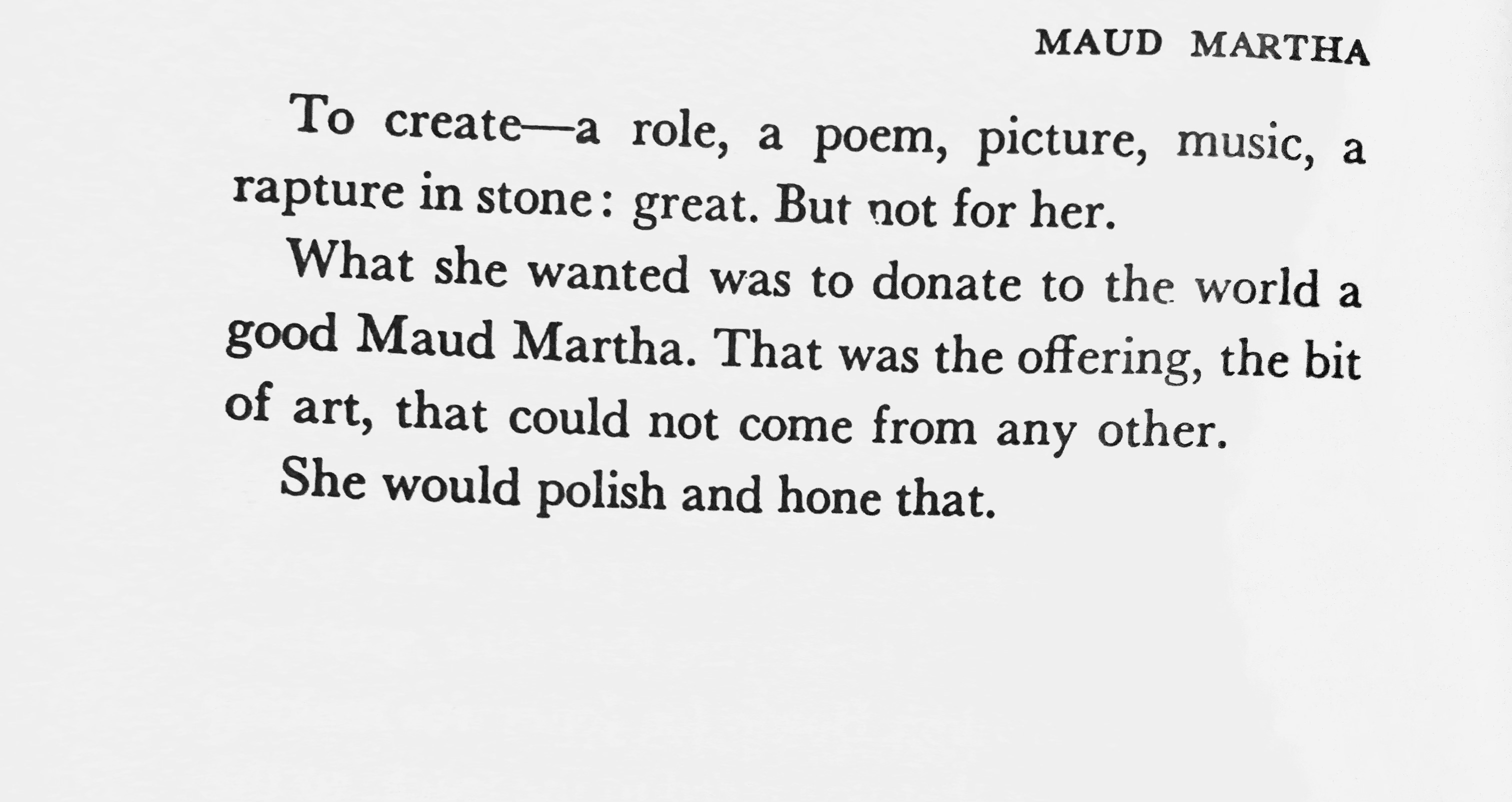
I’m not worried about the state of the novel. That sounds flippant. Beautiful things exist. They don’t stop existing in the wake of other things existing. As to stakes…
Freedom is this intangible gift, but we are always giving it away because security and illusions of certainty are really pacifying. Repetition compulsions are powerful.
In an interview about her new book, three six five, my friend Lucy has said that the gift of a writing practice is intuition. Lucy didn’t say this next part, but I will: choosing to reckon with that intuition via writing, the connection to the future, is a choice. You can choose to do it or you can choose to not do it. I don’t think I’m rare in that I happen to be among those who write about writing — how original, to manifest my sickness (or freedom) this way.
Or maybe the choice is also a curse, depending on the futures you dredge up in the doing. It sounds like I’m talking about something that already happened, even though “We're out here to write sentences the species has never encountered.”
“Every decision in favor of a sentence is a decision against countless other sentences. Every decision in favor of a story passes up countless other stories. One word destroys another word. Writing means obliterating.” (Judith Hermann, trans. Katy Derbyshire)
If I tell you what the book is about— if I say these things are a matter of life and death— I don’t know that saying so makes it any more or less political, life or death.
I do think that if some things are not written down, they die.
Also, if some things are not written, or expelled in writing, they can kill you.
And if these things need to live more than they need to die, then there’s no need to worry that much, because they’re likely to return and live on in the absence of writing.
In the same episode of Mad Men, another office worker imported from the UK relays to Joan: “You Americans don’t know how to handle your emotions— it’s unbecoming.”
Things in the US are very dark; something I’ve thought about in the silence of these past couple of weeks: perhaps what is afforded to us by Fiction is learning how to enter into a more studied relationship with one’s emotions, the world of emotions. I don’t think everyone needs to become a writer or a novelist to have a studied relationship with the world of emotions, particularly one’s own; the profession is a bit foolish, whereas the real work, far less flashy. Sometimes I fantasize about what it is like to be a writer in a society and civilization in an age that is less foolish than ours. But America’s reach is so vast— and Eden was never Eden-for-all, anyway.
Rather than get too hung up with what was possible in some other era, or becoming too attached to any one particular tradition or style of doing things, I’ve tried to focus on cultivating novelty and surprise whenever possible. Part of the essaying I do in this Substack is in that spirit. About a year ago, an editor asked me what I thought about writing a book-length essay; I thought: sure. Maybe it was the start of something, but the conversation never materialized into anything more formal (it may yet, who knows). Because the idea wasn’t one I was so attached to, it has become paradoxically easy to return to in ways that my other projects are not.
I do use writing to explore my thoughts about some of these items, but teaching is also a space where I work this out, if possible (and it is not always possible). Last night, I led a free community writing workshop, “In Search of Spontaneity”— we were about 15 people altogether, and it was a pretty intergenerational mix; a great turn out on a Wednesday night in a rural community of about 700. We read works by Giada Scodellaro, Bhanu Kapil, did some writing together, and closed with a discussion of “XYZ,” a poem by Claire Wahmanholm from her incredible book Meltwater. I felt really energized by the encounter as I had a chance to experience people’s willingness to get together and let themselves be artists without pretense for a couple of hours.
Tomorrow I’m thinking I will head back to the livestock auction before returning home. I’m back on call for NYU summer session to teach The Form of Things Unknown: In Between Prose and Practice through June. We’re reading Roberto Bolaño, who came up in workshop last night (yes, of all places, in Lanesboro, MN); but I was thinking maybe it would be fun to begin with Lydia Davis, from Can’t and Won’t…
