

Not-Writing
Contradictions in full bloom.
Years ago, one of my friend’s brothers shared that his incentive to quit smoking cigarettes was because he was worried about losing his memory. We all smoked cigarettes, but none of us had any idea what Jason was talking about. We were in our early twenties, barely old enough to drink, and when we did drink, it was knowingly or unknowingly part of a larger project that had everything to do with forgetting. “Tell ‘em your theory about how smoking cigarettes kills your memories,” his sister teased. We wanted to know. Jason proceeded to explain how smoking paralyzes the cillia, microscopic information gatherers, in our noses responsible for picking up scent, which in turn contained a well of information. When you paralyze the cillia via exposure to chemicals contained in cigarettes, you dull the connection to the senses, notably smell. “Smell and memory are closely connected,” he affirmed, and we nodded, because we understood this to be common knowledge. So Jason’s theory was if you protect your cillia, and preserve your capacity to smell, then you protect your capacity to form memorable memories. I remember feeling impressed.
None of us quit smoking that night, but the novelty of his theory about memory stayed with me. It never occurred to me that it could have been stolen from Wikipedia, or something more random. Jason was always a bit different; and his theory seemed more like an invention of his imagination, or an expression of his particular style of reasoning, rather than something he overheard. He wasn’t really impressionable like the rest of us in that way.
So maybe there’s some truth to it. I stopped smoking cigarettes nearly ten years ago —although there are perhaps more than a few people reading this who can attest they’ve shared more than one cigarette with me more recently than that. I would like to think my memory is sharper and less blurry than it was (this likely has something to do with writing, maybe more than it does with not-smoking); still, I know memory is not only unreliable, but selective: it often works in service of reinforcing our present feelings and perspectives rather than honoring origins (which is why I am also suspicious of its “spontaneous” appearance in narrative).
I have been thinking of this particular scene because some months ago, when I felt like I needed to plan “suiting up” to return to writing, I felt something new: pain. I am tempted to swap out “pain” for “my age,” but I don’t think these things are synonymous, or at least I want to preserve the distinction and not use language, narrative specifically, to gloss over something that merits deeper consideration. The pain wasn’t debilitating, but my quality of movement, and therefore life seemed compromised in a noticeable way. Perhaps not noticeable to others, but it was felt by me. I was going to the gym, physical therapy, talk therapy. And yet I felt atrophied in some new way that no amount of internet sleuthing or reading or talking out or bodywork seemed to help. I wondered if this pain was something that could not be negotiated, and if, by consigning it to the kind of pain that accompanies aging, if I was accepting its presence (or my helplessness to work through it) prematurely.
Then I became worried when I wondered if my relationship to pain was actually shaping my ongoing relationship to writing, because the way I write (beyond this blog) is so attuned to the realm of sensation. I thought back to Jason’s theory about the cillia, the little cells in my nose. If I worked through the physical pain, confronted it more directly as opposed to wasting energy and mental resources trying to block, ignore, disassociate from, or resent it, what new energy and insight might I have left over? How much of my time and problem-solving abilities was I willing to spend working around my pain? Couldn’t it be reasoned that if I just dealt with it more directly, and made a bigger investment of a different type - to “get to know it” on some deeper level, that I might be energetically freed up in my artistic practice to explore some other realm of sensation?
What lies beyond pain?
More sensation, it turns out. And: more memory! A couple of months ago, I finally committed to seeing a personal trainer as well as a nutritional counselor. I wasn’t looking to “get in shape,” but the recent and increasing Ozempification of my small corner of the world seemed to render something urgent for me: that I figure out for myself sooner rather than later what kind of quality of life I am interested in living: the one I want to live is one where I embrace and respect and stoke my appetite; and one where I have a greater felt sense and belief in my physical integrity.
I don’t expect my desire or ambitions to carry over or translate to anyone else except me; other people are navigating their own clinical, inherited, professional, and personal realities around these items and more. So, taking responsibility for my new interests and priorities has required me to do a bit of a mental and logistical audit on how I schedule and spend my time and energy, because not only do I need and want more time to train, but I also now need more time to rest and cook and eat, and work to afford food and rest and training, and now, healthcare because I make more money and healthcare without an employer or State covering the bill is ungodly expensive. What can I do? Only what I can.
Change can be good. It’s not tolerated by everyone. In my research notes as it relates to the fascia, from Ida Rolf:
What do you mean by pain? What is your attitude toward change?
Humans resist change. Somewhere deep down, they feel that somehow they have ‘made it’ under existing circumstances. What assurance do they have that they’ll continue to ‘make it’ given a different set of circumstances? Conservatism, the tendency to maintain and protect the status quo, to avoid the unknown, to avoid change, is universal.
There’s something political, as I understand it, about being open to change, what lies beyond pain— so understanding how to work with and use gravity — the conditions— is at the core (ha) of reconnecting with individual agency, freedom. This is of personal consequence in terms of addressing the political and exponential freedom-producing potential of writing.
Another Rolfism, I return to, when considering why suffer - what lies beyond change, pain?
At the present state of our knowledge, it would be highly arbitrary to assign a limit to this change, either in respect to structure or time.
I believe Rolf was referring to the body here, more specifically the potential and plasticity of the tissues that form the myofascial network, or elsewhere referred to as “the organ of form.” For my purposes (research, function), I am lumping Rolfing philosophy with insights gleamed from Functional Patterns training (though they are obvi different) because of my general interest in the properties of the myofascial network, particularly as they relate to trauma, neuroplasticity, and writing (see Catherine Malabou’s work, The New Wounded and Ontology of the Accident).
What I admire about Rolf’s theory of Structural Integrity is that with respect to power, potential, freedom, change: the unpredictable, and the unquantifiable are part of the playing field, as much as the quantifiable and inarguable knowns, like gravity, physics, principles of tensegrity.
What constitutes the unquantifiable: strength, heart, capacity, readiness, drive, desire (hence the truism: never underestimate a man’s desire to be free). Those concepts, the unpredictable and unquantifiable, are politically necessary; they are what artists and writers draw upon despite the increasingly impossible conditions. Everyone, whether one is a professional artist or not, should be able to draw from this same source of power (which is why we as a society should care for artists and writers, as well as nurture and cultivate everyone’s artistic sensibilities, not just a select artist class, because these are where we can live these possibilities so very deeply).
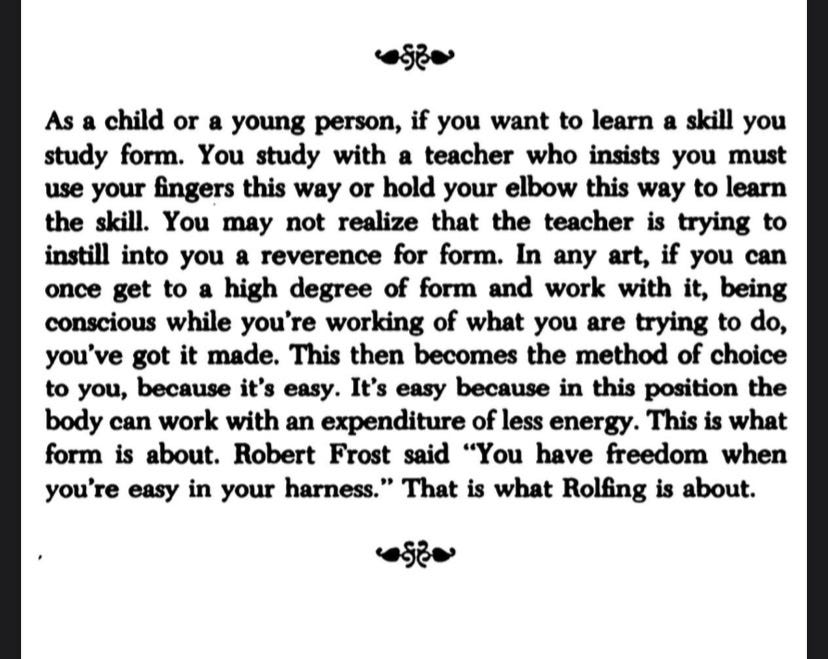
All these transitions have not been without their problems— taking time to work through pain in service of living a more fulfilled life has been lonely and sad in some instances because it has wrought more pain! - and that in turn has required more processing (Rolf: “Rolfing is an approach to the personality through the myofascial collagen components of the physical body” and Feitis: “Rolfing is essentially an experiential art: nonverbal, even noncognitive”).
More processing sometimes = more writing. However, not everything can pass into verbalization. This is actually something I am discovering in the gym. I am hesitant to share a report from “the field” and articulate yet what lies beyond pain, in terms of the kind of feelings or knowledge I’ve encountered over these last few weeks. It’s so private. What comes “after” pain is new, so new, neither I or my trainer, Nick, know how to talk about it yet (we are still new to each other). We may never know. That not all experience can or should pass into language is very counterintuitive for me; I can see how I am really struggling because I use language to make sense of so much (my emotions are really overwhelming!); language is also my symptom, and sometimes I wonder, given how much talk and writing I do, if it is also a kind of topical analgesic, as well as a distraction.
One new discovery I can share: how little words, or narrative, matters in a place like the gym. I won’t say they don’t matter at all, because obviously they do, especially as one tries to map or integrate a new internal, proprioceptive sense of one’s body onto what feels like a confused and senseless place, bringing order and structure, to disorder, chaos. Following directions, and working against unconscious tendencies does require specificity and accuracy. But narrative is secondary, and sometimes unhelpful or unnecessary, if the primary goal is action.
When I was working out alone, I never had occasion to think about this. Working solo (as when one is writing), one’s patterns likely resume unchallenged, unnoticed.
It is very hard to work against a tendency and habit: that is true at the gym and in writing.
It’s like, you can’t smell what you can’t smell.
But when you add another person into the mix, truth/story/memory/narrative gets complicated, and I’ve started to wonder, beyond psychoanalysis, if some of the stories I’ve been carrying about myself really serve any purpose apart from reinforcing some old and inaccurate ideas. Unknowns: is there a thing as too much change, too soon?